Blog
What's New in Radiology AI: From Triage to Autonomous Reads
Radiology seems to dominate medical AI. As of March 2026 the FDA had cleared 1,524 AI-enabled medical devices, and 1,163 of them (over 76%) were for radiology.[1] Cardiology is a distant second at 146, while most other specialties like OB/GYN, ENT, and the rest have only a handful each. So what is all that radiology AI actually doing? Here's a glimpse across the spectrum.
⏱️ Reading time: ~4 minutes
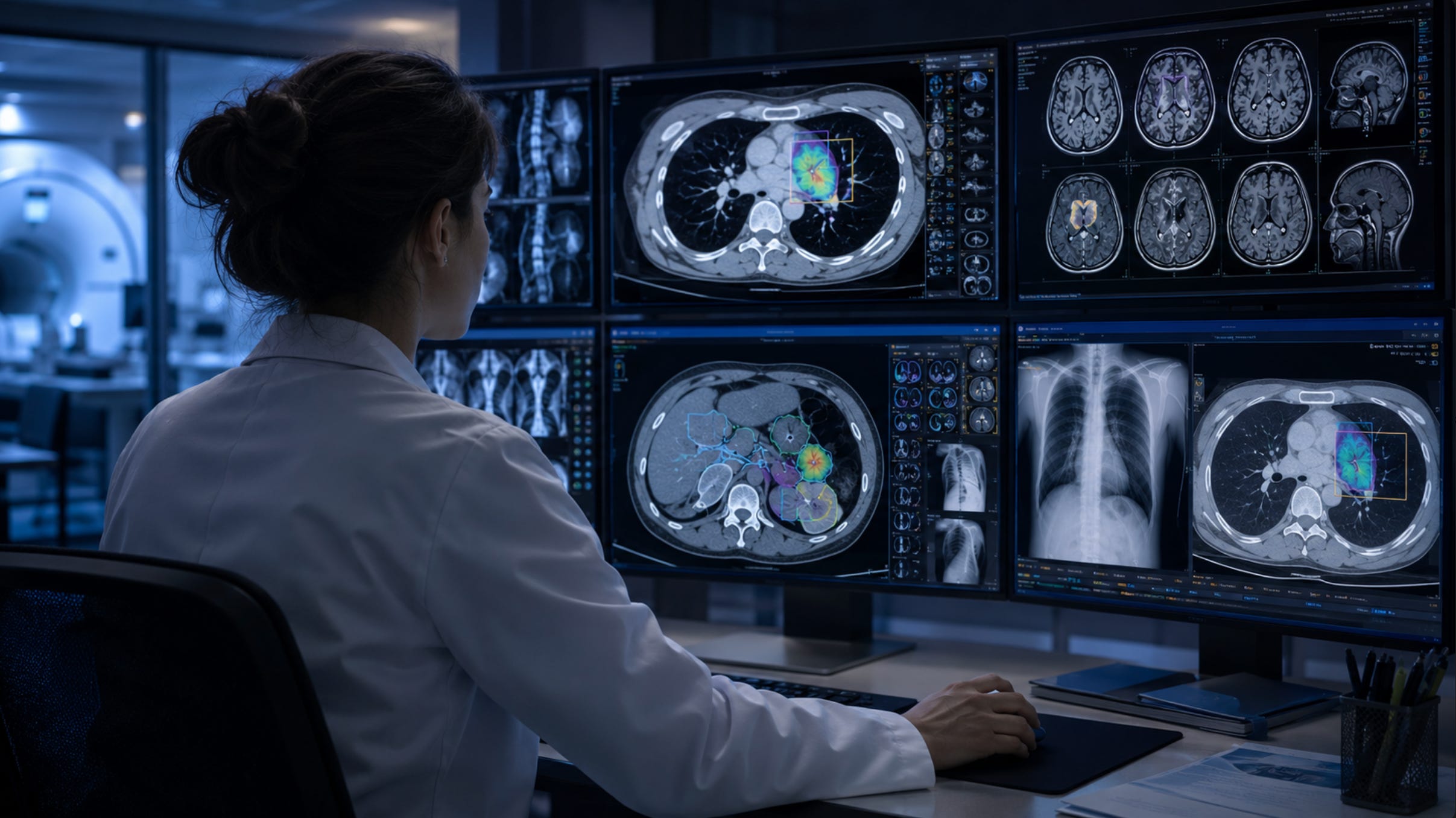
(AI-generated illustrative image)
🧠 Viz.ai LVO: Alerts the Stroke Team
Viz.ai LVO was the first AI triage software the FDA ever cleared, back in 2018.[2] It scans a CT angiogram (CTA) for a large vessel occlusion (LVO), and when it finds one it pushes the images and an alert straight to the on-call stroke team’s phone.[2] In an independent single-centre study of 282 patients (presented at a 2022 conference, not yet peer-reviewed) it reached about 91% sensitivity and 88% specificity; the company reports higher figures (96%/94%) from its own validation.[3] It prioritises; it does not diagnose: a case it does not flag has not been ruled out, so radiologists still read every scan.
🧠 Harrison.ai: Flags Early Cerebral Infarcts
Eight years on, triage moved one scan earlier. In March 2026 Harrison.ai was FDA-cleared to flag acute cerebral infarcts on the non-contrast head CT, the first scan in suspected stroke, which is done mainly to rule out haemorrhage.[4] On that scan early ischaemic change is subtle and easily missed, so a tool aimed at catching it addresses a real blind spot. Per the company, it detects early ischaemic injury across six vascular territories of the brain, with over 80% sensitivity and specificity and up to 89.2% sensitivity on thin-slice scans.[4]
🎗️ Clairity Breast: Predicts 5-Year Risk
Most breast AI reads the current mammogram for cancer that is already there. Clairity Breast instead estimates a woman’s five-year risk of developing breast cancer from a mammogram a radiologist has already called cancer-free, drawing on subtle imaging features the human eye doesn’t pick up.[5] It received FDA de novo authorisation in 2025, reported as the first tool to predict five-year risk from a mammogram alone. In 2026 it was added to the NCCN (National Comprehensive Cancer Network) breast cancer screening guidelines.[5][6] In data presented at RSNA 2025 and applied to over 245,000 mammograms, women it flagged as high-risk had a 5.9% five-year cancer rate versus 1.3% in the average-risk group — a separation that held after adjusting for breast density.[7]
🩻 Aidoc CARE: One Model, Many Emergencies
Some tools now go for breadth instead of a single finding: a model covering many conditions at once. That helps workflow, but wide coverage is not the same as proven accuracy on each finding. Aidoc CARE is built on a “foundation model”: a single AI trained broadly, then adapted to many tasks rather than built for just one. In practice, from one abdominal CT it can flag a range of acute findings: splenic, liver and kidney injury, pelvic fracture, intestinal ischaemia.[9] The FDA cleared it in January 2026 with 11 new indications plus three existing ones (14 in total); the company reports the 11 averaged 97% sensitivity and 98% specificity — an average across indications, so per-finding performance varies.[8]
🩻 qXR-Detect: The Chest X-Ray Assistant
Qure.ai gained FDA clearance in February 2026 for six chest X-ray indications on its qXR-Detect tool (computer-aided detection, or CADe).[10] Per the company, the qXR family returns pre-read assistance in about 20 seconds,[11] drawing boxes around suspicious findings across six regions — lung, pleura, mediastinum/hila and heart, bone, hardware, and other — pointing the reader to what may need a closer look.[10]
🩻 Oxipit ChestLink: Auto-Clears Normal X-Rays
Oxipit ChestLink goes a step further than the tools above: it does not just flag findings, but it signs off. A CE Class IIb-certified autonomous AI, it identifies chest X-rays it judges normal with high confidence and removes them from the worklist without a human read. The company reports 99.9% sensitivity for correctly identifying normal studies — a vendor figure that has not been independently validated.[12] Note the scope: it auto-clears normal films; it does not autonomously report pathology. In April 2026 Sweden’s Sectra, a medical-imaging IT company, completed its acquisition of Oxipit.[13] The autonomous mode is CE-marked in Europe but the product has no FDA clearance for autonomous use, and how Swiss law treats fully autonomous reporting, plus the liability question of who answers for a “normal” no human ever saw is unsettled.
🔮 On the Horizon: Finding Disease Nobody Was Looking For
The next shift is opportunistic screening: using AI to mine a scan — taken for one reason — for early signs of something else. A routine chest or abdominal CT already carries data on bone density, coronary calcium, fatty liver, and muscle loss, which normally goes unread. AI can extract these automatically, turning a single scan into a broader risk check; some radiologists anticipate this could become part of routine CT in the coming years.[15]
⚠️ What Radiology AI Still Cannot Prove
So far, most of these tools are judged on accuracy and how well they flag a finding. Very few have shown that better flagging leads to better outcomes: fewer disabling strokes, earlier curable cancers, lower mortality. That evidence will take more time.
🇨🇭 FDA, CE — and What Counts in Switzerland
Two labels recur above. An FDA clearance covers the US market only; a CE mark (Conformité Européenne) covers the EU. For Switzerland, the CE mark is what matters: Swissmedic runs no separate approval of its own, so an FDA clearance alone is not a valid route to the Swiss market (yet) — the Federal Council decided in April 2025 to open a dedicated pathway for FDA-approved devices, but that route is still being worked out. A CE-marked device can in principle be placed on the market here, but Swiss rules add their own requirements (a Swiss authorised representative, product registration in Swissmedic’s swissdamed database from 1 July 2026, importer obligations), so CE marking is necessary but also not automatically sufficient.[14]
👉 More on AI in cardiology, the runner-up above, in our earlier piece: [Link]
📚 Sources
Radiology Business. Radiology gets 68 new FDA-cleared algorithms. 25 Jun 2026. Link
Viz.ai. De Novo FDA Clearance for First AI Triage Software. PR Newswire, 2018. Link
Viz.ai. Real-World Experience With Automated LVO Detection (n=282). AHA Stroke 2022 abstract. Link
Harrison.ai. FDA clearance for acute infarct triage on non-contrast CT Brain. 2026. Link (see also Applied Radiology)
FDA. De Novo — Clairity Breast (Allix5), DEN240047. Authorised 30 May 2025. Link
NCCN Guidelines — Breast Cancer Screening and Diagnosis, v.2026. Link (announced via OncLive and Clairity/GlobeNewswire, 14 Apr 2026)
RSNA. AI Tops Density in Predicting Breast Cancer Risk. RSNA 2025. Link
Aidoc. FDA Clearance for First Comprehensive Foundation Model AI. PR Newswire, 21 Jan 2026. Link (see also STAT News)
Aidoc. Comprehensive Abdomen CT Triage — product page. Link
Qure.ai. Six New FDA Indications for qXR-Detect. BusinessWire, 26 Feb 2026. Link
Qure.ai. qXR — product page. Link
Oxipit. ChestLink. Link
Sectra. Sectra completes Oxipit acquisition. PR Newswire, 15 Apr 2026. Link
FOPH/BAG. Medical devices legislation. Link
AJR. Opportunistic Imaging: 2026 Status Update and Future Outlook (Forum). 11 Mar 2026. Link
Liked this? Get new articles in your inbox.
Subscribe