Blog
Why Clinical AI Doesn’t Care About Your Hochdeutsch
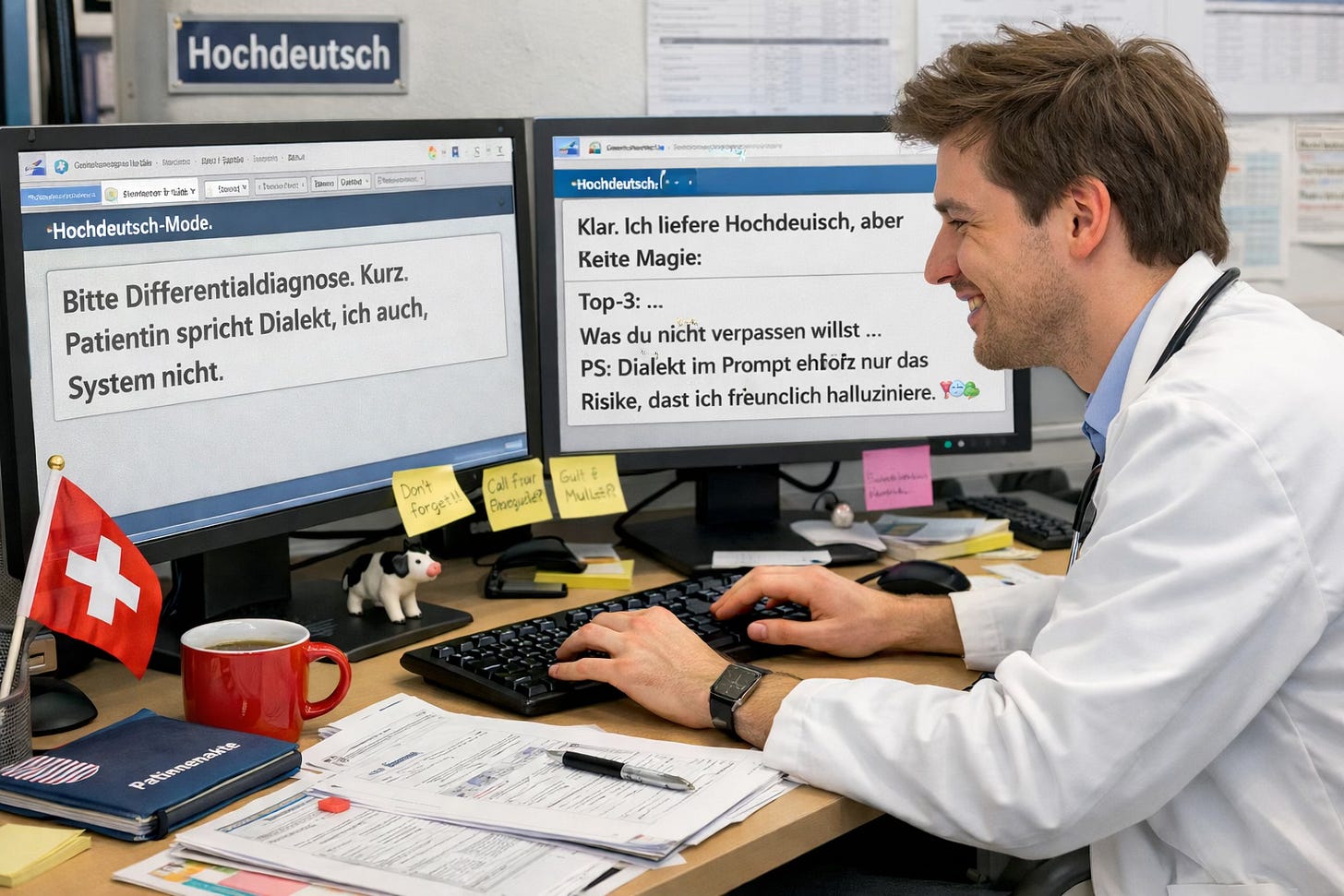
The practical answer: use a hybrid workflow
Input: your clinical working language (DE/FR/IT)
Process instruction: “Analyze using international medical literature and standard medical terminology.”
Output: the language you need for documentation and handoffs
Why this works: it separates reasoning from documentation clarity and keeps your prompts auditable.
Example: 03:00 admission note in Swiss German → prompt “Summarize using standard medical terminology” → structured output in German for your clinical information system.
Four key facts
1) English is the default knowledge substrate
As of December 2023, 86.5% of PubMed-indexed publications were in English.
That matters because training and evaluation data often reflect what is most available.
2) “English is always better” is not a fact
Multilingual performance varies by model and task, so claims should be benchmark-based, not anecdotal. Medical multilingual benchmarks like MedExpQA exist specifically to measure cross-language differences.
Takeaway: English is often a reasonable default for complex reasoning, but it is not a safety guarantee.
3) The bigger risk is messy input
What reliably worsens outputs is not “German vs English”, it is ambiguity and noise:
unstructured histories (e.g. “pt unwell since days, maybe fever?, meds??, unclear past medical history”)
inconsistent terminology (e.g. mixing “Luftnot”, “dyspnea”, “can’t breathe” without onset or severity; “renal failure” without stage or creatinine)
copy-pasted patient messages (e.g. long chat text: “I feel weird… heart skipping… since yesterday… btw could I be pregnant??”)
mixed languages in one prompt (e.g. “Anamnese: seit 3 Tagen Fieber. Triage: douleur thoracique 7/10. DDx: PE vs pneumonia. Angehörige: ‘sie isch hüt mega komisch gsi’.”)
The Swiss trap: “copy-paste soup” (note fragments, patient messages, and dialect) is not a prompting strategy.
Rule: normalize, structure, and use clinical terms before asking for reasoning.
4) Swiss-specific tools are emerging, with caveats
AlpineAI’s SwissGPT: AlpineAI states SwissGPT can be used in all Swiss national languages and in English. But language support is not the same as clinically validated performance.
Apertus (EPFL/ETH/CSCS, Swiss AI Initiative): Apertus is presented as a large-scale open, multilingual Swiss model trained on 15 trillion tokens across 1,000+ languages, including Swiss German and Romansh. At the same time, Apertus is primarily a general-purpose LLM, and its medical usefulness depends on domain adaptation, clinical evaluation, and appropriate governance.
Bottom line
Routine work: local language is fine.
Complex reasoning: English is often reasonable, not guaranteed better.
Always required: clinical judgment, verification, and missing-data checks.
LLM outputs are decision support, not decisions.
Sources
Hamad AA. Medical research production in native languages: descriptive analysis of PubMed. Qatar Med J. 2024. PubMed: https://pubmed.ncbi.nlm.nih.gov/38746849/
Alonso I, Oronoz M, Agerri R. MedExpQA: Multilingual benchmarking of LLMs for medical QA. 2024. arXiv: https://arxiv.org/abs/2404.05590; journal: https://www.sciencedirect.com/science/article/pii/S0933365724001805
AlpineAI. SwissGPT language support (Safety page). Accessed 2026-01-19. https://alpineai.swiss/en/safety/
Swiss AI Initiative. Apertus (official project page). Accessed 2026-01-19. https://www.swiss-ai.org/apertus
ETH Zurich. Apertus press release. 2025-09-02. https://ethz.ch/en/news-and-events/eth-news/news/2025/09/press-release-apertus-a-fully-open-transparent-multilingual-language-model.html
Liked this? Get new articles in your inbox.
Subscribe