Blog
Three ChatGPTs and Counting: Making Sense of Healthcare AI
🇬🇧 English edition. Auf Deutsch lesen.
ChatGPT Health. ChatGPT for Clinicians. ChatGPT for Healthcare. MedGemma. Dragon Copilot. Claude for Healthcare. In 2026, every major tech company released a healthcare AI product — and most of them sound like variations of the same thing. This guide explains what each one actually does and who it is for.
⏱️ Reading time: ~4 minutes
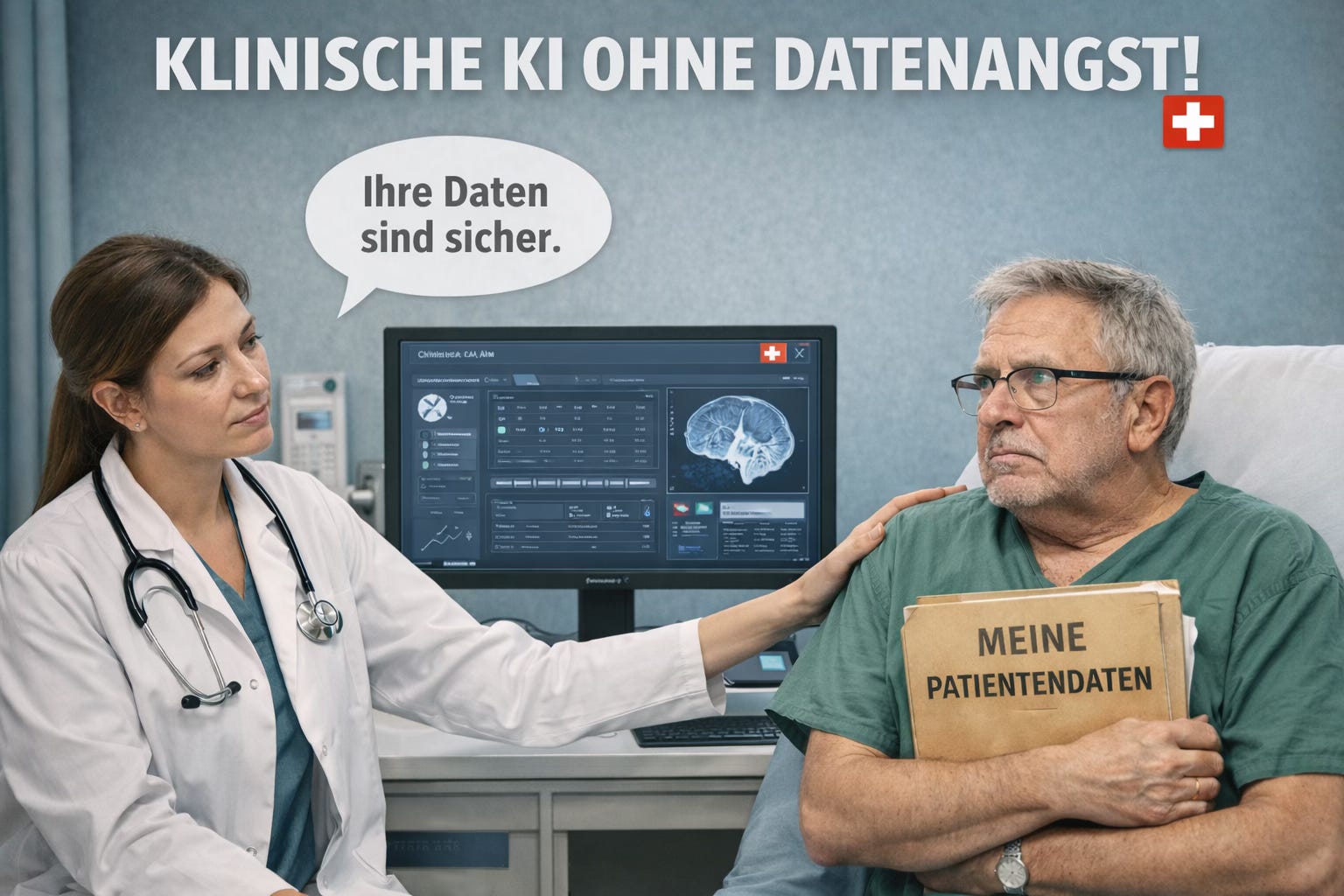
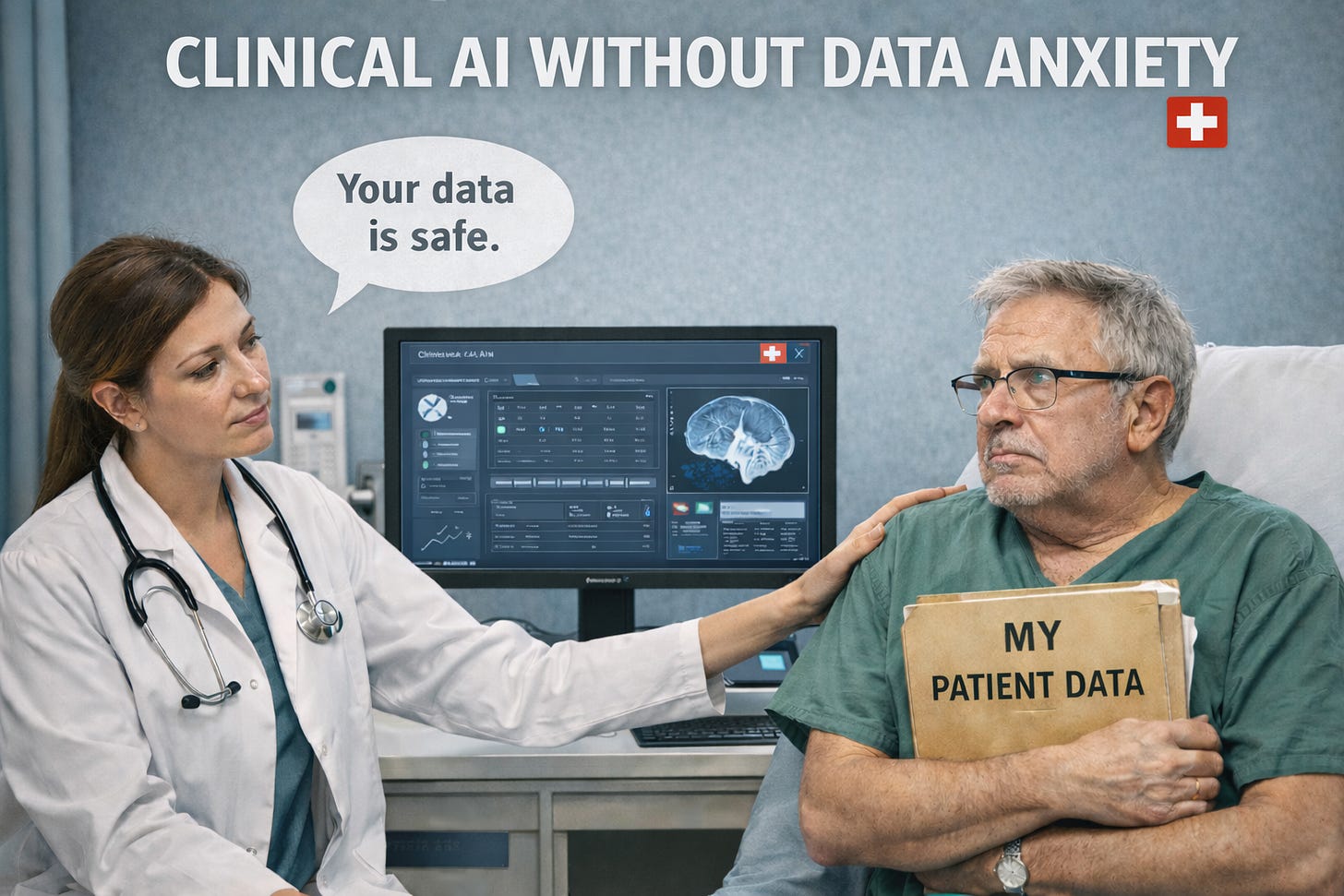
🔐 One thing to know first: data and the law
Several US tools are not available in Europe. OpenEvidence — a popular clinical AI used by hundreds of thousands of verified physicians in the US — pulled out of the EU and UK in early 2026, citing regulatory uncertainty [1]. This matters for any US tool you consider: US law includes provisions (the CLOUD Act) that can require American companies to share stored data with US authorities, regardless of where that data is held — a conflict with GDPR (General Data Protection Regulation) that remains legally contested.
🧠 OpenAI: three products, one confusing name
OpenAI has three healthcare products. They all say “ChatGPT.” They are not the same.
• ChatGPT Health — for patients. Explains lab results in plain language, syncs with fitness trackers.
• ChatGPT for Clinicians — for verified doctors. Clinical questions and evidence search with peer-reviewed citations.
• ChatGPT for Healthcare — for hospitals. A version of ChatGPT configured to know your hospital’s own guidelines, drug lists, and clinical workflows. Handles documentation, patient intake, and administrative tasks.
The one most physicians ask about is ChatGPT for Clinicians. It is free and includes a research mode that cites peer-reviewed sources [2]. According to OpenAI, hundreds of medical advisors reviewed over 700,000 model responses — with 99.6% rated as safe and correct in clinical testing [2]. Notably, the tool showed no advantage over physicians in direct patient consultation tasks [2]. The catch for European physicians: verification requires an NPI (National Provider Identifier), a US-specific credential. A rollout across other countries is planned but not yet confirmed [2] — For readers who want to explore the Swiss context in more detail, this Medinside article provides additional background and perspective (German) Medinside article (DE).
🔬 Google MedGemma 1.5: powerful imaging AI — but not for doctors yet
MedGemma 1.5 was released in January 2026 [3]. It can analyse 3D CT and MRI scans, tissue samples under the microscope, and chest X-rays — significantly better than its predecessor [3]. It is not an app you open: it is open-source code that software developers use to build new tools. Google is explicit that it is not validated for direct clinical use [3]. Think of it as the engine inside future radiology support tools — not something to use in practice today.
🛠️ Microsoft Dragon Copilot: ambient documentation
Dragon Copilot listens to your patient consultation and automatically writes a structured clinical note, which you then review and sign. In 2026, Microsoft expanded it beyond note-writing: it now suggests diagnostic codes using ICD (International Classification of Diseases) terminology and can draft referral letters in real time [4]. It connects to major EHR (Electronic Health Record) systems including Epic and is rolling out across Europe in 2026 [4].
🧾 Anthropic Claude for Healthcare: not really for physicians
Claude for Healthcare is built for hospital billing teams and insurance authorisation workflows. It connects to ICD coding registries and is designed for administrative and health-tech teams — not individual clinicians.
🇨🇭 Meditron: the Swiss option
Meditron is an open-source medical AI model developed at EPFL (Swiss Federal Institute of Technology Lausanne), trained on peer-reviewed medical literature and international clinical guidelines [5]. Its main advantage: it runs entirely within a hospital’s own servers, so patient data never leaves the building. Following an evaluation with healthcare staff using hypothetical clinical cases in 2025, the CHUV (Centre Hospitalier Universitaire Vaudois) is set to begin testing Meditron in their emergency department in May 2026 [5].
Beyond the US AI: Made in China
Worth knowing: DeepSeek-R1, a Chinese open-source model, performs comparably to proprietary AI on clinical benchmarks according to a Nature Medicine study [6] — and like Meditron, can be run locally. However, its Chinese origin raises data sovereignty questions for European institutions.
👤 For patients: ChatGPT Health and Perplexity Health
Two consumer-facing tools are worth knowing about when patients ask. ChatGPT Health (OpenAI) syncs with fitness trackers and explains lab results in plain language.
Perplexity Health, launched in March 2026, connects Apple Health, wearables, and health records from over 1.7 million care providers to answer personal health questions [7]. Both are designed to help patients prepare for a doctor’s visit — not to replace one.
However, early independent evidence suggests caution: recent studies show that general-purpose medical AI can miss urgent scenarios and should not be relied on without clinical oversight (see No.4: AI in Research: 5 Recent AI Studies).
🔎 What each tool does — at a glance
ChatGPT for Clinicians — clinical questions and evidence search with citations. For physicians (US only for now).
Dragon Copilot — writes your clinical notes during the consultation. For physicians.
MedGemma 1.5 — interprets CT, MRI, and histopathology. Foundation for future tools; not yet for direct clinical use.
Meditron — Swiss open-source AI that runs locally on hospital servers. For institutions.
Claude for Healthcare — medical coding and insurance workflows. For admin and billing teams.
ChatGPT Health / Perplexity Health — personal health questions using wearable and health record data. For patients.
📚 Sources
[1] OpenEvidence EU/UK withdrawal — Let’s Data Science
[2] ChatGPT for Clinicians — Medinside.ch (DE); HIT Consultant
[3] MedGemma 1.5 — Google Research Blog
[4] Dragon Copilot — ORdigiNAL; HIT Consultant
[5] Meditron / CHUV — SWI swissinfo.ch
[6] DeepSeek-R1 clinical benchmarks — Nature Medicine
[7] Perplexity Health — Modern Healthcare
Liked this? Get new articles in your inbox.
Subscribe