Blog
How Far Has AI Really Spread in European Hospitals?
⏱️ Reading time: ~3 minutes
WHO (World Health Organisation) surveyed every EU country on AI in health care [1]. Most of the report is policy detail. One part is genuinely interesting — it shows what AI tools health systems report using, and how established that use is.
⚠️ What the Data Actually Measures
This is a self-reported survey: national coordinators answered questions about their own health system, and WHO compiled the results [1].
“Established” means a category of AI is in routine use for 2+ years at the country level. It does not mean the technology is clinically validated or proven to improve outcomes.
📊 What’s Reportedly Being Used
Seven AI categories, rated as informal, pilot, or established [1]:
Diagnostic imaging AI — in use in 74% of countries; established in 41% [1]
Chatbots for patients — in use in 63%; established in 30% [1]
Admin task automation — in use in 59%; established in 22% [1]
Symptom checkers — in use in 44%; established in 15% [1]
Surgical robotics support — in use in 41%; established in 22% [1]
Prognosis/risk prediction tools — in use in 48%, established in only 11% [1]
Remote patient monitoring — in use in 41%; established in just 7% [1]
Imaging and chatbots lead — but that’s adoption breadth, not a verdict on which tools work best. Validated decision-support tools may exist in specific indications (oncology, intensive care, early-warning scores) that these seven broad categories don’t separate out.
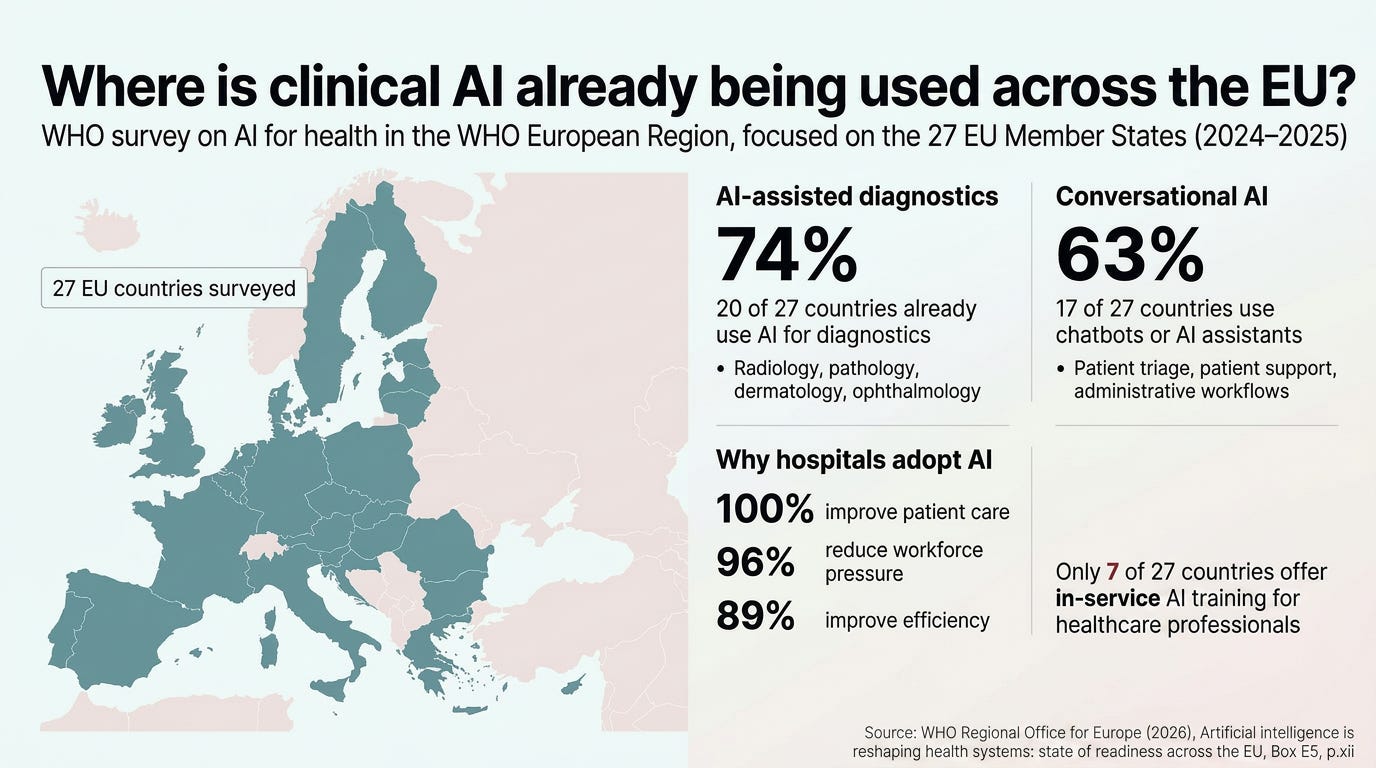
AI is already in clinical use across most of the EU. Data: WHO, 2026 [1]. Graphic generated by SwissMedAI.
💡 Why Hospitals Are Buying AI
Nearly every country cites the same reasons [1]:
1. Improve patient care (100%)
2. Ease staff pressure (96%)
3. Boost efficiency (89%)
Adoption looks driven by workforce strain more than novelty.
🎓 AI Training Remains Limited
Only 26% of EU countries report offering ongoing AI training to clinicians; 22% include it in medical school [1]. In the DACH region, Austria is among the seven countries offering in-service training; Germany did not report having one[1]. This is a country-level figure, not a measure of individual physician knowledge — but it’s reasonable to infer that training gaps translate into uneven preparedness on the ground.
⚖️ The EU AI Act, Simplified
The EU AI Act treats most clinical AI — diagnostics, triage, decision support — as high-risk [1]. Starting August 2026, these tools must:
show you why they made a recommendation
let you override the recommendation
come with documented accuracy testing [1]
Swiss procurement teams are increasingly checking this, even though Switzerland isn’t directly bound by the Act.
🔍 What We Still Don’t Know
This survey shows what countries report using, not whether those tools are safe, effective, or validated for the clinical questions they’re applied to.
Two questions worth asking: is diagnostic imaging the most-reported category because it performs best, or because it was easiest to deploy and report on? And where does Switzerland, still not surveyed and with no comparable national assessment, actually stand in all this?
📚 Source
WHO Regional Office for Europe. Artificial intelligence is reshaping health systems: state of readiness across the European Union. Copenhagen: WHO Regional Office for Europe; 2026. Document: WHO/EURO:2026-12707-52481-81471.
Liked this? Get new articles in your inbox.
Subscribe