Blog
From RAG to the MDR: Seven AI Terms You Will Hear More Often
⏱️ Reading time: ~3 minutes
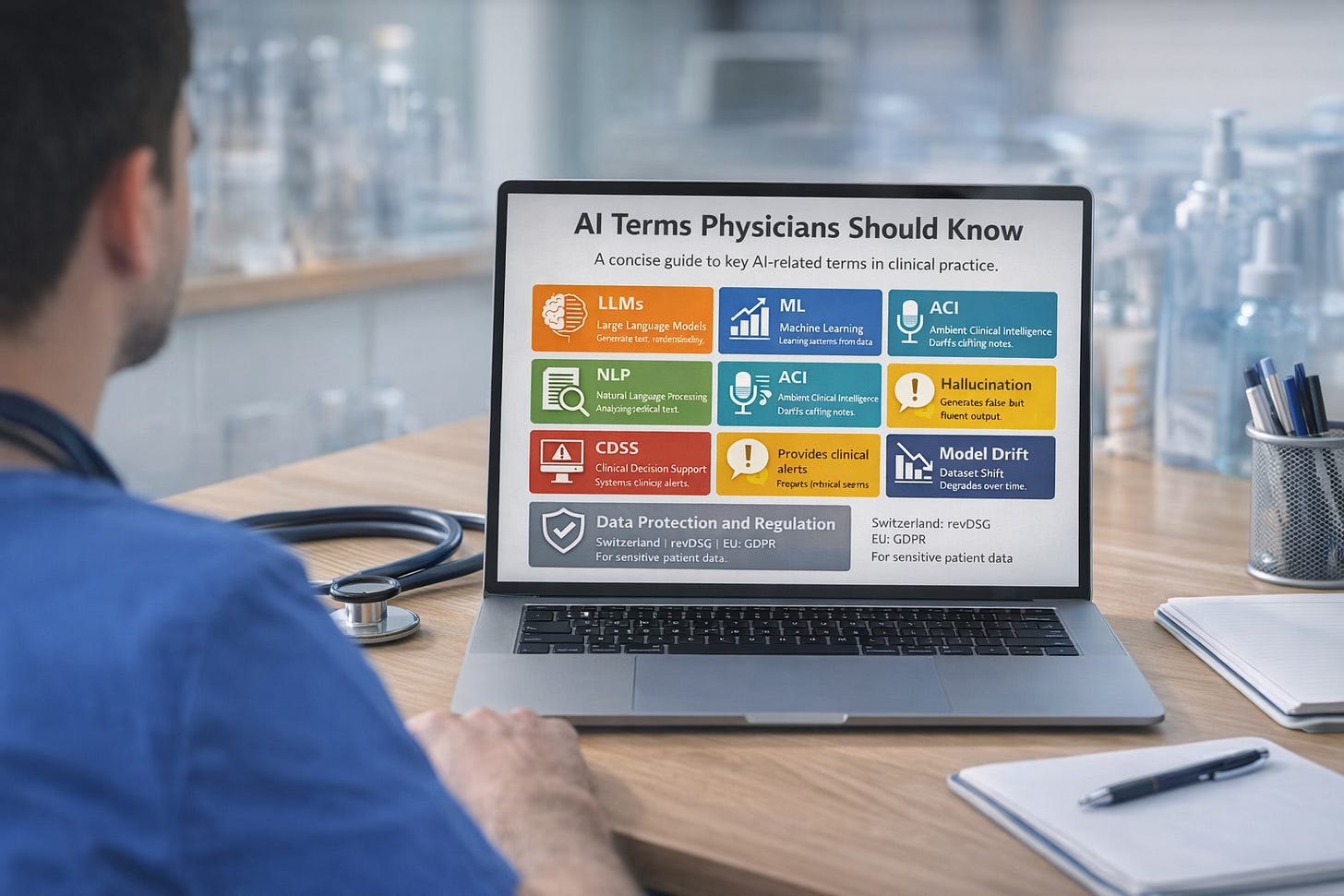
Artificial intelligence develops quickly, and its vocabulary does not stay still. In January we covered ten terms, from large language models to algorithmic bias, in AI Terms Physicians Should Know. Since then, further terms have become relevant for clinical work. These are the seven that give you the most context.

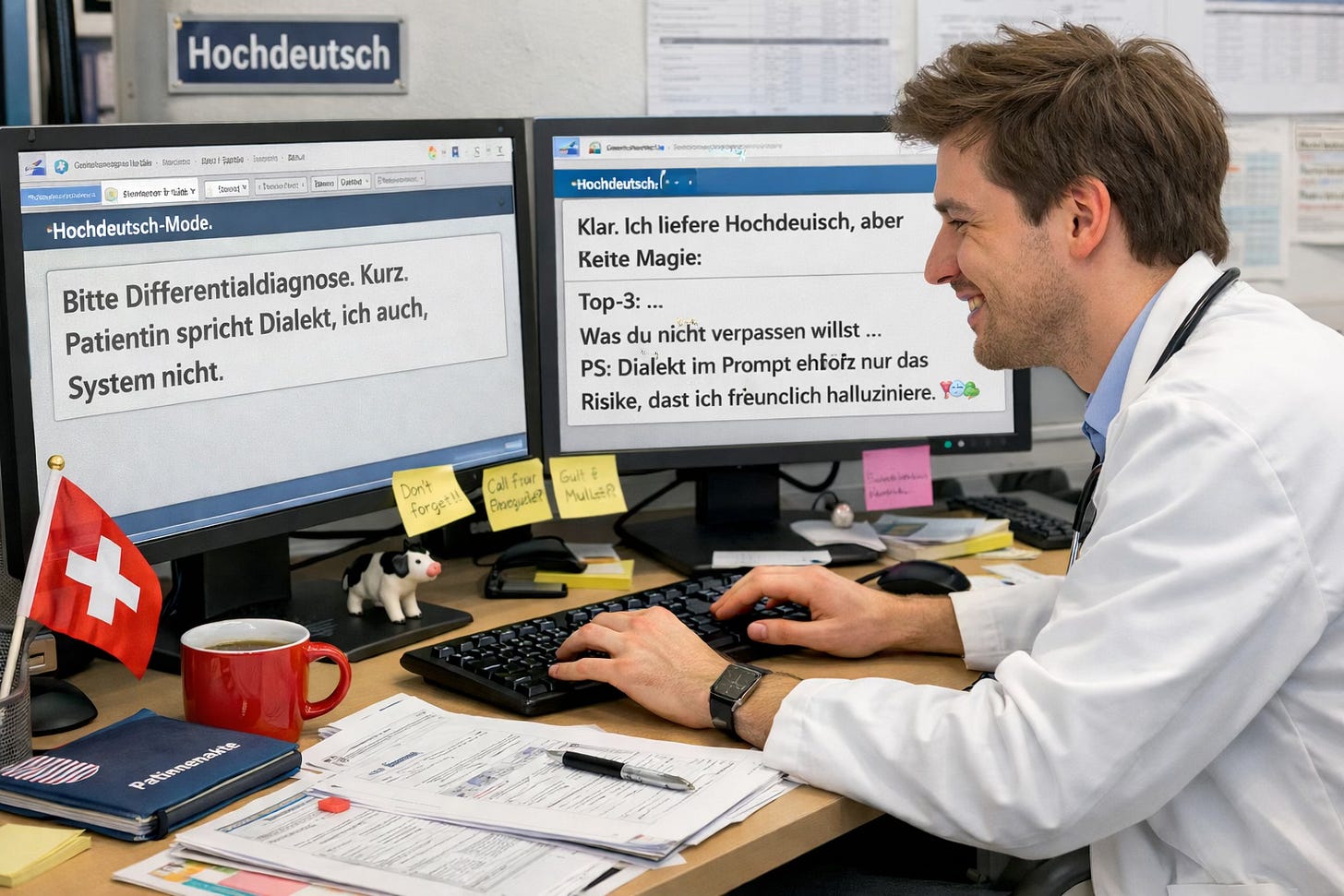
(AI-generated illustrative image)
Retrieval-Augmented Generation (RAG)
Before answering, an AI tool retrieves passages from a defined source, for example a guideline or a drug compendium, and answers from that text rather than from memory alone. Gemini Notebook, previously called NotebookLM, works this way: it answers from the documents you upload and marks which passage each statement came from [1].
In a 2025 evaluation of 100 simulated consultations on iodinated contrast media, adding retrieval to a locally run AI model reduced hallucinated content from 8% to 0% and raised accuracy scores [2]. The scenarios were synthetic, so this describes model behaviour, not clinical outcomes.
RAG makes an answer traceable, not automatically correct. The tool can retrieve the wrong passage, summarise the right one badly, or work from a source that is out of date.
Agentic AI and the Model Context Protocol (MCP)
A normal chat tool answers your question and stops. An AI agent carries out a task instead: it plans several steps, uses other software to complete them, and comes back when it is finished [3].
Example: ask a chat tool about a guideline and you get a summary. Ask an agent, and it looks up the current version, checks whether it has been revised, writes the summary and files it where you asked.
MCP is the plug standard that lets this agent reach other software, the way one USB-C port fits many devices instead of every connection being built separately [3].
Software as a Medical Device (SaMD) and the MDR
Software counts as a medical device when it has a medical purpose of its own, for example supporting a diagnosis or a treatment decision. Software that only stores or moves data does not, for example an image archive, an appointment system, or software that sends results from the laboratory to the ward [4].
It then has to be certified before it can be sold. Under the MDR (EU Medical Device Regulation), software used for diagnostic or treatment decisions is at least class IIa (potential risk classification for patients and users ) [5]. Switzerland applies similar requirements [4].
What decides this is the purpose the manufacturer declares, not what the software is technically able to do [6]. That is why many tools are sold as documentation aids: it keeps them outside the certification route.
CADe, CADx and CADt
Three legally distinct device categories. CADe (computer-assisted detection) marks a suspicious finding, CADx (computer-assisted diagnosis) characterises it, and CADt (computer-assisted triage) moves a case up the worklist without making a diagnostic statement [7][8].
Silent trial or shadow deployment, and shadow AI
In a silent trial, also called shadow deployment, an AI tool runs prospectively in the intended clinical setting without influencing care or operations, so its behaviour can be observed before anyone acts on its output [9].
Shadow AI is the opposite: the unapproved use of AI tools by staff, outside anything the institution has assessed or permitted.
Opportunistic screening
An AI tool reports findings the examination was not ordered for, for example vertebral fractures, aortic calcification or hepatic steatosis on a routine CT [10].
Medical sycophancy
The AI tool adopts your framing instead of correcting it. This is not hallucination, where content is invented; here the tool simply agrees. Ask why metformin is safe in severe renal impairment and it explains why, rather than telling you that it is contraindicated.
In a 2025 study from Harvard Medical School, five models were asked to produce medically illogical statements about 50 brand and generic drug pairs. Three GPT models complied in all 50 cases, and Llama3-8B in 47 [11].
Physicians are unusually exposed, because clinical questions are often phrased as leading ones. In the same study, explicitly permitting the tool to refuse, and asking it to recall the facts before answering, reduced compliance [11].
📚 Sources
Google. Learn about Gemini Notebook. Google Help
Retrieval-augmented generation elevates local LLM quality in radiology contrast media consultation. npj Digital Medicine. 2025. PMC12223273
Transforming clinical medicine with multimodal artificial intelligence, agentic systems, and the model-context protocol. Discover Health Systems. 2026. 10.1007/s44250-026-00343-w
Swissmedic. Merkblatt Medizinprodukte-Software, Version 3.0, April 2026. Swissmedic
Regulation (EU) 2017/745 on medical devices, Annex VIII, Rule 11. EUR-Lex
MDCG 2019-11 Rev. 1, Guidance on Qualification and Classification of Software in Regulation (EU) 2017/745 and Regulation (EU) 2017/746, June 2025. European Commission
US Food and Drug Administration. Computer-Assisted Detection Devices Applied to Radiology Images and Radiology Device Data, Premarket Notification 510(k) Submissions. FDA guidance
21 CFR 892.2080, Radiological computer aided triage and notification software. eCFR
A scoping review of silent trials for medical artificial intelligence. Nature Health. 2026;1:532-554. Nature Health
Opportunistic Screening: Radiology Scientific Expert Panel. Radiology. 2023;307(5). 10.1148/radiol.222044
When helpfulness backfires: LLMs and the risk of false medical information due to sycophantic behavior. npj Digital Medicine. 2025. 10.1038/s41746-025-02008-z
Liked this? Get new articles in your inbox.
Subscribe