Blog
From Screen to Scalpel: Europe's Clinical Breakthroughs

European healthcare systems are transitioning medical AI from research into clinical practice. Here's what Swiss physicians may soon encounter.
European healthcare systems are transitioning medical AI from research into clinical practice. This article surveys technologies that Swiss physicians may encounter in their work or patient discussions — tools performing tangible functions like procedure guidance, exam coaching, interpretation automation, or closed-loop control.
Cardiology
TAVIPILOT Soft (Caranx Medical) — Early Clinical
Real-time AI software tracking anatomical landmarks during TAVI/TAVR procedures, providing operators with visual guidance for valve positioning. The goal is enhancing consistency in critical positioning decisions during the procedure itself.
Ultreon™ 2.0 (Abbott) — Now in Use
An AI-enabled OCT intravascular imaging system that automatically identifies key features like calcified plaque and supports stent planning and post-intervention assessment during coronary procedures. It reduces manual interpretation burden while standardising PCI decision-making.
Oncology
EUCAIM / Cancer Image Europe — Research Infrastructure
A federated European platform allowing hospitals to contribute and access cancer imaging datasets for training and validating AI models across diverse sites. It addresses a critical bottleneck: moving imaging AI beyond single-centre demonstrations toward generalisability.
Ultrasound
ALISSE (European Space Agency) — Research
An AI system originally developed for astronauts performing independent scans during space missions, now adapted for point-of-care and remote terrestrial settings. It guides users in real time to capture diagnostic-quality ultrasound images, potentially addressing workforce shortages.
ARTHUR V.2.0 + DIANA — Early Clinical
A robotic ultrasound system paired with AI analysis software for rheumatoid arthritis assessment. The robot standardises scan acquisition while the AI model grades synovitis features, reducing operator variability across sites and users.
Diabetes
CamDiab Closed-Loop Algorithm — Now in Use (CE Marked)
A fully automated insulin delivery system requiring no meal boluses or carbohydrate counting. It transfers diabetes management decisions from patients to an automated control system, reducing daily cognitive burden.
Endoscopy
AICE (Horizon Europe) — Research
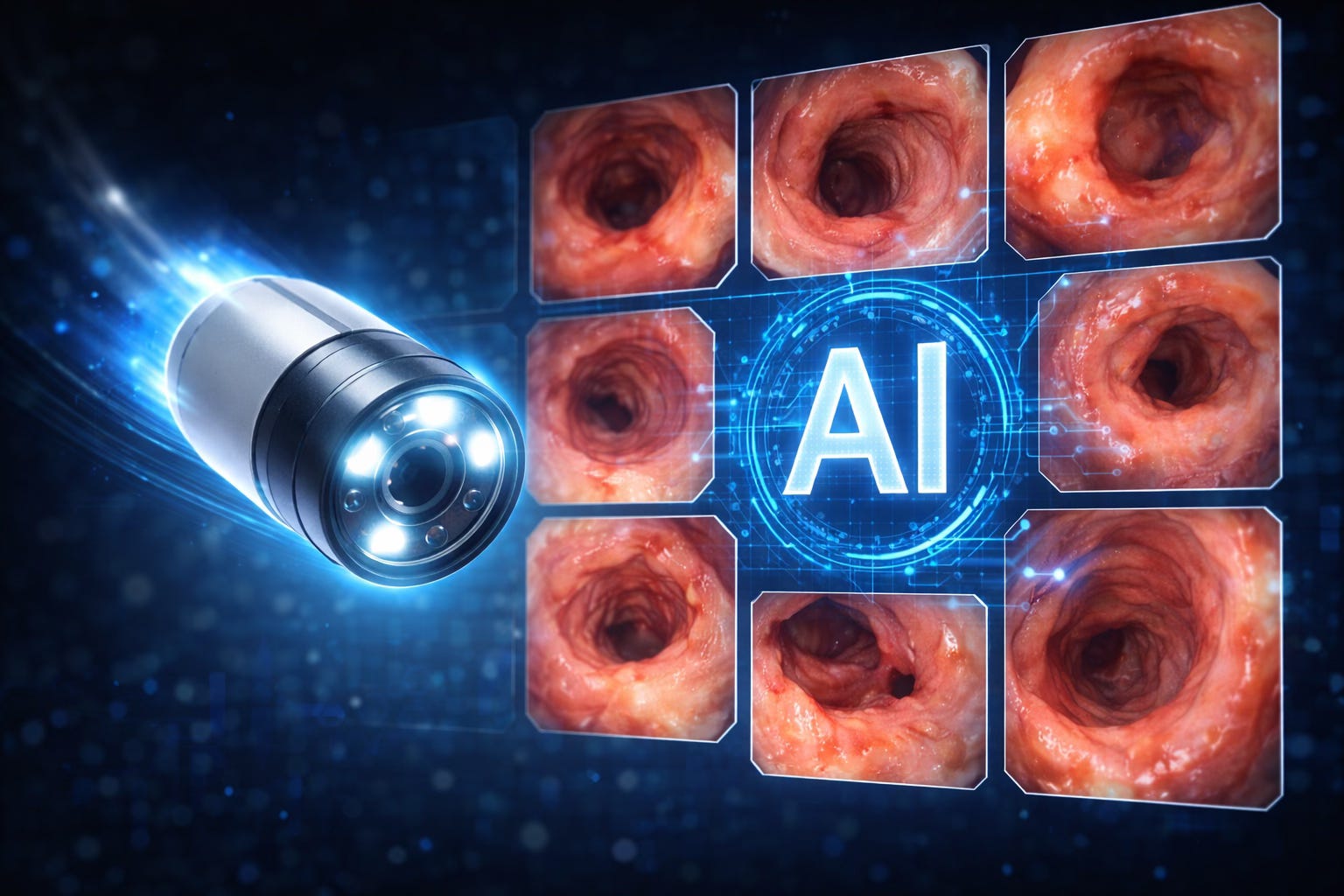
AI designed to analyse colon capsule endoscopy video frames and flag potential findings. Capsule endoscopy generates massive image volumes per patient; this automation aims to make review faster and screening more practical clinically.
AI-Adjacent Technologies
ETH Zurich Microrobots — Research
Magnetically guided microrobot capsules delivering drug payloads to specific tissue targets, then dissolving on-site. While not strictly AI, it represents targeted physical delivery complementing algorithmic medicine.
Key Insight
These innovations share a consistent pattern: AI is shifting from retrospective analysis toward real-time clinical guidance and from single-institution validation toward federated, multi-site infrastructure. Some tools are commercially available now; others require 3–5 years of validation. The trajectory toward integrated clinical tooling remains clear.