Blog
AI Terms Physicians Should Know
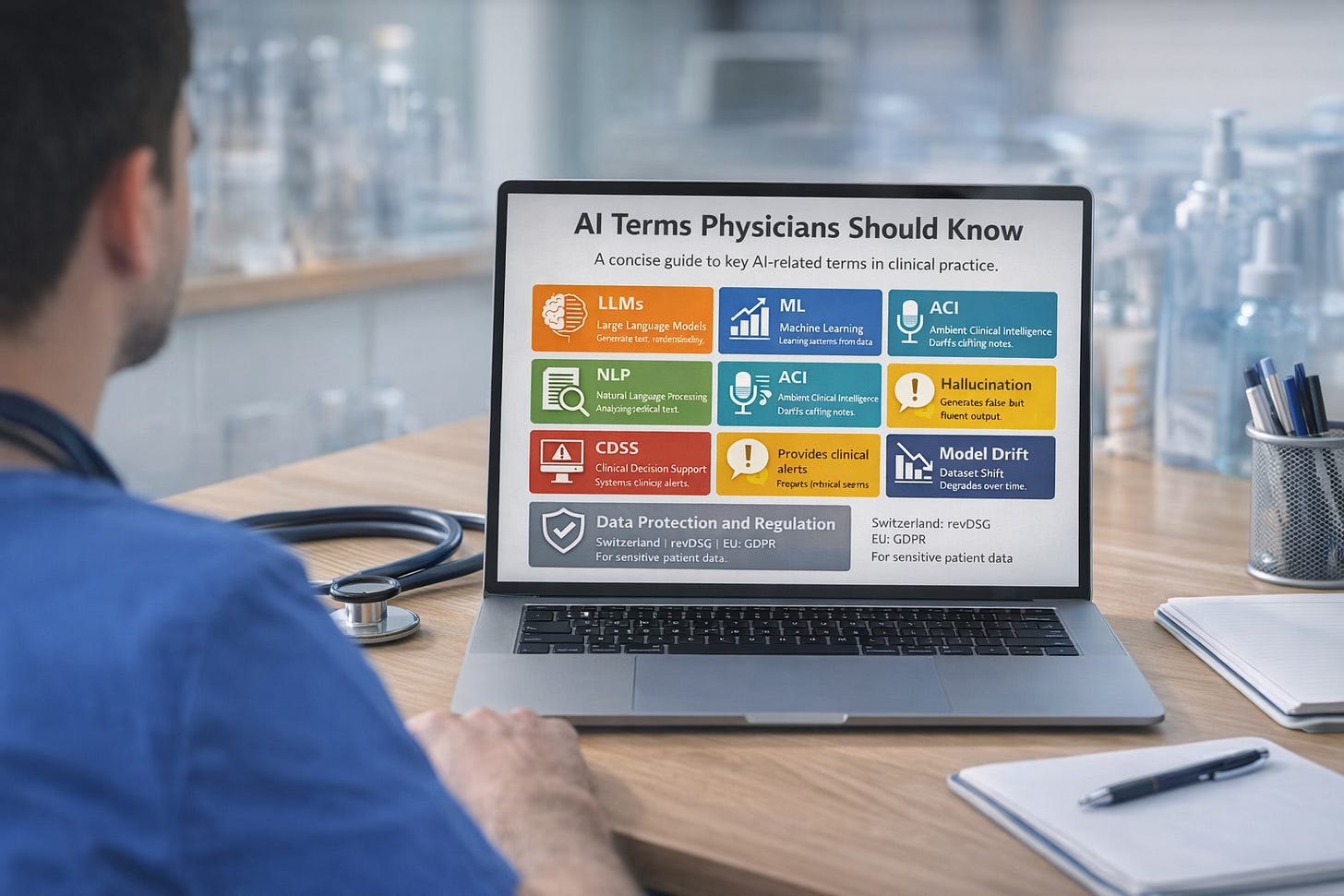
A concise glossary of AI terms physicians will encounter in clinical practice, research, and healthcare software descriptions.
This glossary summarises key AI-related terms that are frequently used in clinical practice, research, and healthcare software descriptions. The aim is a concise, technically sound orientation without unnecessary technical detail.
LLMs (Large Language Models)
Generate text by calculating statistically likely word sequences, not by understanding meaning.
Models such as ChatGPT, Claude, or Gemini are general-purpose language models, not medical systems.
ML (Machine Learning)
Learns patterns from existing data and therefore inherits errors and biases present in those data.
Performs only as well as the data on which it was trained.
NLP (Natural Language Processing)
Enables software to recognise, analyse, and structure unstructured medical text.
Forms the basis for allowing computers to “read” clinical notes and extract relevant information, for example for coding, quality analysis, or searching large text corpora.
ACI (Ambient Clinical Intelligence)
Captures conversations between clinicians and patients and automatically generates draft documentation.
The generated text often appears highly plausible but may contain subtle inaccuracies.
Commonly used to pre-draft anamnesis and progress notes.
CDSS (Clinical Decision Support Systems)
Provide alerts or warnings about potential risks without making decisions themselves.
Typical use cases include drug-drug interaction warnings, risk alerts, or reminder systems.
Hallucination
Refers to the generation of factually incorrect content that is linguistically convincing and therefore difficult to detect.
Example:
“According to the ESC Guideline 2023, ivabradine is recommended as first-line therapy in stable angina.”
Sounds credible, but is fabricated.
Algorithmic Bias
Occurs when training data underrepresent or distort certain patient groups.
Leads to systematically poorer model performance for specific populations.
Model Drift / Dataset Shift
Describes declining model performance as data or clinical contexts change over time.
Causes include new guidelines, shifting patient populations, or changes in clinical workflows.
Human-in-the-Loop
Means that AI outputs are reviewed by a human before being used.
Considered a minimum standard for clinically relevant AI applications.
Data Protection and Regulation (Switzerland)
revDSG (Revised Federal Act on Data Protection): Governs how patient data may be collected, processed, stored, and shared.
DSFA (Data Protection Impact Assessment): Required when introducing systems that pose increased risks to patients’ rights, particularly AI tools processing sensitive health data.
GDPR (General Data Protection Regulation): Relevant when EU-based providers, servers, or cross-border data processing are involved.